Prayer is Radar
Computational Theology 101
In 1971, Herbert Benson brought a group of Transcendental Meditation practitioners into a lab at Harvard Medical School and wired them to every instrument he could get his hands on. Benson was more interested in the nervous system than enlightenment. His subjects sat down, closed their eyes, and repeated a single Sanskrit syllable. Then they did, by every external measure, nothing.
But the instruments disagreed. Oxygen consumption dropped. Heart rate slowed. Blood lactate (a marker of metabolic stress) fell sharply. Alpha brain waves, the signature of a quiet and alert mind, increased. Benson, trained to read the body as a machine, was watching the machine change gears without being told to.
He called it the “relaxation response.”
The response was universal. It appeared in Buddhist monks, Franciscan nuns, Sikh chanters, and secular subjects repeating the word “one.” Six different techniques. One distinct physiological signature. Measured. Catalogued. Published.
What Benson could not do was explain it.
Why had every human civilization, without exception, independently invented some version of the same practice? Sitting still. Narrowing attention. Directing consciousness toward something beyond the self. And why did it work? It didn’t just relax the body, it sharpened moral intuitions, clarify decisions, and produced what practitioners across traditions describe, in weirdly convergent language, as alignment with something true and real?
Thirty years later, Andrew Newberg at the University of Pennsylvania injected radioactive tracers into the bloodstreams of Tibetan monks and Franciscan nuns at the peak of their practice and imaged their brains. Two consistent patterns emerged. The parietal lobe (the region that constructs the boundary between self and world) went quiet. The prefrontal cortex (the seat of directed attention) lit up. The brain as an oxymoron, narrowing its focus while simultaneously expanding its aperture.
When he couldn’t explain his findings, he coined the term “neurotheology.” Like Benson, he couldn’t explain the convergence. He could show what the brain did during prayer. He could not say why.
There is an answer.
Not a psychological answer, though the psychology is consistent. Not a neurological answer, though the neurology supports it. A structural answer — grounded in the mathematical framework of the Ruliad and Observer Theory — that explains not just what prayer does to the brain, but why the mechanism exists at all, and why every civilization found it.
1. The Navigation Problem
Imagine you’re standing at a junction in a city you have never visited, without a map, and you need to reach a specific building somewhere in the sprawl. You can see three blocks in any direction. You can evaluate the immediate cost of each road — this one is steep, that one is crowded, the third looks smooth but curves away from where you think the building might be. You cannot compute the full route. The city is too large, the streets too interconnected, the consequences of each turning painfully dependent on each subsequent turning.
This is the human condition.
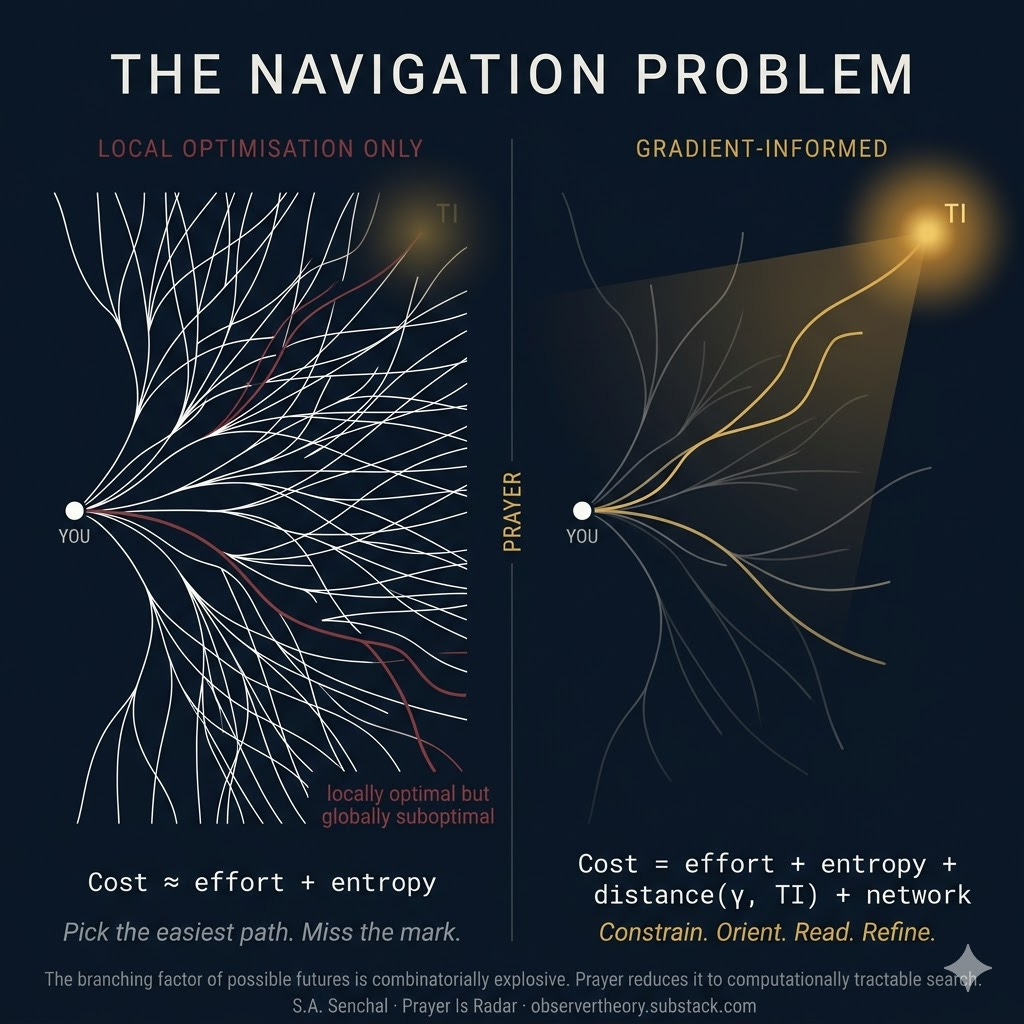
In Observer Theory, every conscious agent occupies a ‘position’ in the space of all possible computations (formalized as an ∞-groupoid whose objects are computational states and whose morphisms are transitions between them1). You sample this infinite structure through a finite window. You attend to a further subset of that window at any given moment — what I’ve termed “the Observer’s Field”. And you navigate by evaluating available paths against a path cost function.2
Plain English: The cost of any path through life equals the (computational) effort it requires, plus the waste (entropy) it generates, plus how far it leaves you from the deepest available good (distance to your ultimate goal), plus its effects on other people (network effects).
The first two terms — effort and entropy — are personal. The tiredness after a long day. The mess left behind by a reckless decision. Your mind evolved to track these.
The third term is where we run into problems.
Distance(γ, TI) measures proximity to the terminal object of the Ruliad’s categorical structure, the convergence point of all possible computations (i.e. the point in this abstract universe where every possible computation has ‘completed’).
In the God Conjecture, I have shown that this can be taken as mathematical, structural analogue to what theology calls God: necessary, containing all possibilities, simultaneously transcendent and immanent. Every object in the Ruliad has exactly one step to it.
This term requires global information you don’t have. It is the bearing on a compass whose magnetic field you cannot perceive. Without it, your path cost function collapses to local optimization: pick the easiest path that makes the least mess.
This is what the ancient Greek hamartia means — missing the mark. Not because you aimed wrong, but because you were navigating without a compass.
2. Prayer is Gradient Estimation
How does a finite agent approximate global information?
In optimization theory, the answer is gradient estimation. When you cannot differentiate a cost function directly (because the landscape is too vast, or non-smooth, or irreducible) you estimate the direction of improvement through sampling. You probe. You send a signal and read the return. You adjust your heading based on what comes back.
This is what prayer does.
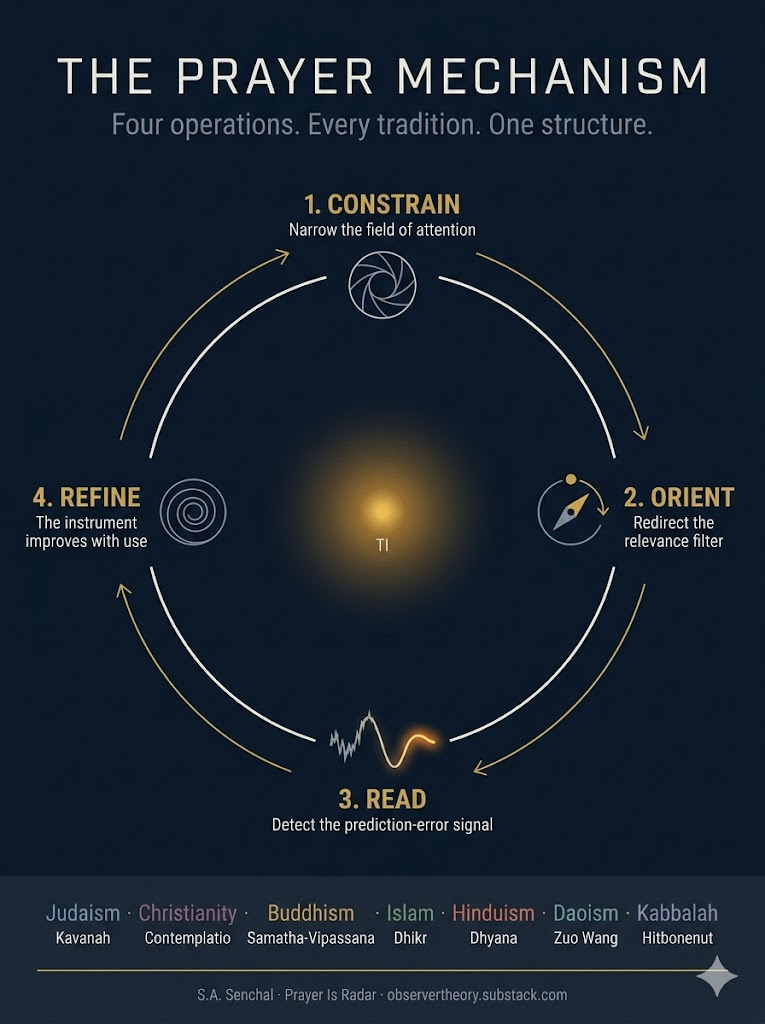
Prayer is any process that performs four operations on an Observers navigation system:
First, it constrains the field of attention. By narrowing focus prayer reduces the effective branching factor of the decision space. You stop trying to evaluate every possibility and attend only to those your heuristic indicates are promising. In AI, this is called beam search. In monasteries, it’s called discipline.
Second, it reorients the relevance filter2. Under normal conditions, your attention tracks evolutionary priorities: food, threats, status, mating. Prayer overrides these defaults and redirects attention toward patterns correlated with the global gradient — toward what the traditions, in their various languages, call the ultimate, the absolute, the ground. Your sampling apparatus, briefly, stops scanning for predators and starts scanning for north.
Third, it reads the prediction-error signal. Under Friston’s FEP, all persistent systems minimize the divergence between their internal model and external reality. When you reorient toward the global gradient, the prediction-error signal carries alignment information. Low prediction error (experienced as peace, clarity, a sense of rightness) indicates your model is well-calibrated to the gradient direction. High prediction error (experienced as dissonance, agitation and resistance) indicates misalignment.
The feeling of peace during prayer (for serious practitioners) is no placebo. It’s the signal. It is qualitative gradient information.
Fourth, it refines the instrument. Each session modifies the weighting function that determines how you integrate / structure information into your internal model. Repeated practice physically restructures the brain (prefrontal thickening, enhanced coupling) making the practitioner more sensitive to the gradient signal. This is why every tradition insists that prayer is a practice.
The compass improves with use.
The four-step cycle — constrain, orient, read, refine — repeats. Over a lifetime of practice, navigation converges from locally-driven stumbling toward globally-informed pilgrimage.
Consider the structured information you gain from the minimal computational investment. By any measure it’s extraordinary.
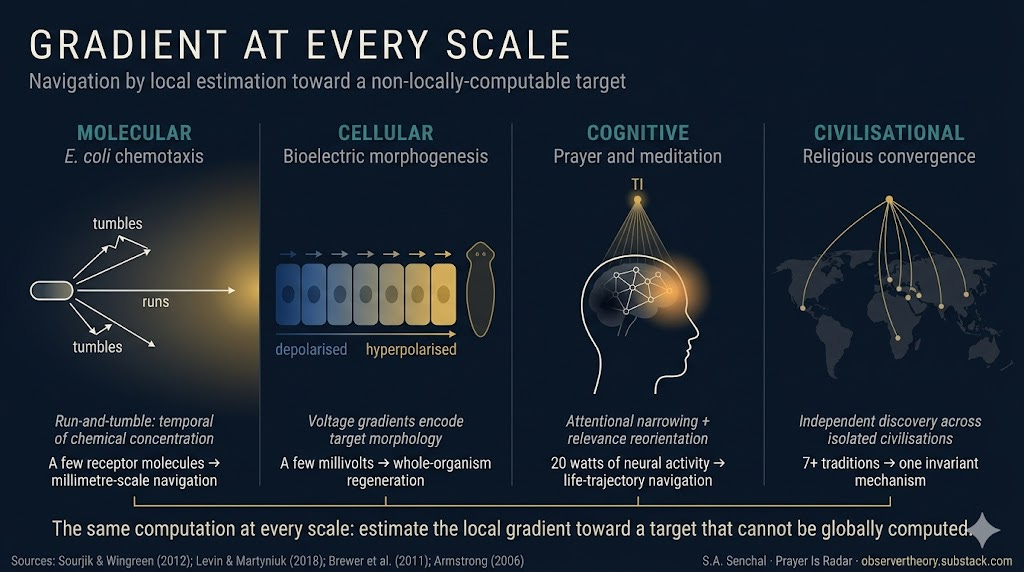
The metabolic cost of sitting still and directing attention is roughly the brain’s 20-watt baseline. The return — information on which direction “better” lies, potentially redirecting an entire life trajectory — exceeds the computational cost by orders of magnitude.
Any technology with returns like this will be independently discovered by any sufficiently complex agent.
3. Why the Gradient Exists
An obvious objection pops out: what exactly are we estimating?
If the gradient is a projection of your own values onto an indifferent landscape, then prayer devolves to active self-persuasion. Useful, but not ontologically “real.”
The objection has teeth. It’s basically Dennett’s position applied to contemplative practice: stick to the functional mechanism, forget everything else. I can hear his beardy gum flaps admonishing me from beyond the grave: Prayer works because it reduces cognitive load and activates the parasympathetic nervous system, dumbass3.
The answer is that the gradient isn’t a construction (at least in Wolfram’s physics model!). It is a topological consequence of the Ruliad’s structure. In the space of all possible computations, there exists a limit point at which all paths converge. This point exists by mathematical necessity (terminal objects are standard category theory architecture), the same way the centre of mass exists in a physical system. You do not need to believe in the centre of mass for gravity to pull you toward it.
The analogy to physics is not decorative. Gravitational singularities physically exist. A black hole’s event horizon marks a literal boundary beyond which all trajectories converge toward the singularity. It’s a topological feature of spacetime, not a convention. The God Conjecture posits that TI (True Infinity, the terminal object in the Ruliad) is an analogous feature of computational geometry. Just as spacetime curvature creates gradients that physical objects follow, the Ruliad’s structure creates gradients that Observers follow.
This principle is seen at every biological scale.
E. coli performs chemotaxis (via a biased random walk): it swims in one direction, compares chemical concentration now to chemical concentration a moment ago, and if conditions are improving it keeps swimming; if conditions worsen it tumbles to randomize direction. This is stochastic gradient estimation at the molecular level, a bacterium approximating the direction to a nutrient it cannot see, using local temporal comparisons, with an evolutionarily optimized signaling network. A few receptor molecules carry enough information to navigate millimeter-scale gradients. The IRCI is enormous4.
Michael Levin’s work on developmental bioelectricity demonstrates the same principle at the cellular scale. All cells produce and sense electrical signals, and these bioelectric circuits guide cell behavior toward specific anatomical endpoints. When a planarian flatworm is bisected, each fragment regenerates the correct body plan by following local voltage gradients that encode the target morphology. A few millivolts of membrane potential carry enough information to reconstruct an entire organism.
Gradient-following toward a target state that cannot be globally computed is not a cultural invention. It’s fundamental biological computation, operating all the way from ion channels to contemplative monks. Prayer is its instantiation in Observers Like Us.
Now the convergence argument. If the gradient were merely a projection of culturally specific values, then different civilizations should’ve produced different “optimal” directions. Independent constructions, operating on different cosmologies and social structures, should diverge.
They do not.
Every persistent tradition converges on the same four-step mechanism and on convergent phenomenological reports: dissolution of self-boundary, sense of alignment, directional clarity, moral transformation. This convergence across civilizations that had zero contact with each other — documented by Karen Armstrong across the Axial Age, confirmed by Newberg’s imaging across contemporary practitioners of different faiths — is explained if the gradient is external. Different agents detecting the same structure will converge on the same readings.
If every civilization independently invented the compass, and every compass pointed the same direction, you would be right to conclude there was a magnetic field. You would not, like Dennett5, conclude that every culture happened to develop the same hallucination.
4. What the Brain Shows
The neuroimaging literature, read through this framework, moves from a catalogue of correlations to a description of a new mechanism.
The DMN — the voice in your head that will not shut up — goes quiet when experienced meditators sit down to pray. It goes quiet regardless of the tradition. Tibetan concentration, Christian loving-kindness, Buddhist choiceless awareness — Brewer’s team at Yale tested all three. Same result. The system is not relaxing. It is shutting down the channels that carry limited gradient information, freeing bandwidth for the channels that do.
Simultaneously, Newberg’s studies show the parietal lobe, which constructs the self-other boundary, has less activity while the prefrontal cortex has more. The aperture widens. The focus sharpens. This dual operation is the neural signature of the first two steps: constrain the search space, reorient toward the signal.
The physiological data tells the same story at a different resolution. Benson’s relaxation response is the nervous system shifting from sympathetic to parasympathetic dominance: from high-entropy undirected scanning (fight-or-flight, sample everything, respond to anything) to low-entropy directed search (follow the gradient, conserve resources). The cortisol drop documented across every prayer and meditation tradition is the biochemical marker of this transition. Cortisol is the molecule of directionless alarm. Its suppression during prayer indicates the system has found a bearing and is following it.
Long-term practice restructures the baseline architecture. Brewer found stronger functional coupling between monitoring and control regions in experienced meditators, not only during meditation but at rest. The instrument, refined by years of use, maintains enhanced sensitivity even when not formally engaged. This is the second-order insight that every tradition encodes as doctrine: prayer changes not just your current state but your capacity to navigate. Von Foerster’s dictum — “the observer observes the observing” — acquires a neurological substrate.6
5. What The Traditions Knew
In Judaism, the word for directed prayer intention is kavanah (literally, “direction”). The Amidah, the central standing prayer recited three times daily, follows a structured ascent: praise, then petition, then thanksgiving7.
This is a gradient-estimation sequence. Praise aligns the frame. Petition identifies the gap. Thanksgiving integrates the signal.
Aryeh Kaplan, in Jewish Meditation, describes hitbonenut (contemplative prayer) as a systematic technique for expanding awareness while maintaining directional focus. Open the aperture. Sharpen the lens. Read what returns.
Christianity formalized the gradient-reading step with unusual explicitness. Ignatius of Loyola’s rules for discernment of spirits, codified in the 16th century, classify the prediction-error signal: “consolation” as peace, clarity and movement toward God, indicates alignment. “Desolation” as anxiety, confusion, movement away, indicates divergence8. The Hesychast tradition’s Jesus Prayer, repeated thousands of times in rhythmic coordination with breath, is pure attentional narrowing: strip away every signal except the bearing.
Buddhism’s architecture makes the two-phase structure explicit.
Samatha (calm abiding) constrains the field to a single object: the breath, a visual point, a phrase. The branching factor drops from thousands to one. Then vipassana (insight) scans the constrained field for structural information about the nature of experience. This is equivalent to trust-region methods in numerical optimization: first define a region of reliability, then optimize within it. The combination explains why traditions that emphasize only calm (concentration without insight) or only inquiry (analysis without stability) are consistently described by masters across lineages as incomplete. You need both phases.
The same mechanism appears in Islamic salat where its five daily prayers function as periodic gradient recalibration (the body literally turns toward Mecca, just like Jews are meant to pray in the direction of Jerusalem). In Hindu dhyana, describe progressive attentional narrowing (dharana → dhyana → samadhi) until only the gradient signal remains. In Daoist zuo wang (sitting and forgetting) Zhuangzi prescribes stripping away the ego, preference, and conditioned responses to reach wu wei (effortless action), the state in which path cost is locally minimized. In Kabbalistic meditation, prayer ascends through four worlds — Assiyah, Yetzirah, Beriah, Atzilut — each step moves up the hierarchy toward Ein Sof.
The words differ. The cosmologies contradict. The computational structure is always, always, always the same: constrain the field, reorient the filter, read the signal, refine the instrument. The phenomenological reports converge: a sense of direction, of contact, of being drawn toward something that was already there.
This convergence is the article’s central evidence. Independent discovery of the same four-step mechanism by every persistent civilization, producing convergent brain signatures and convergent reports of experienced alignment, is what you would expect if the mechanism is detecting an objective feature of reality.
6. Objections
If prayer is gradient estimation, what are psychedelics?
Removing the lens cap on a telescope. Psychedelic states, which also suppress the default mode network, enhance inter-network connectivity, and produce reported experiences of contact with something ultimate, flood the Observer with unfiltered signal. Enormous but noisy information. This explains why traditions that incorporate psychedelics invariably pair them with meditative discipline. You need the raw signal and the trained instrument. A telescope without a tracker shows everything and navigates by nothing.
If the gradient is real, why do some people pray and make terrible decisions?
Because the mechanism can be corrupted. Prayer directed at false objective functions — tribal supremacy, personal wealth, destruction of enemies — constrains attention toward a local attractor. The four-step process works, but the target is wrong. This is why every mature contemplative tradition distinguishes between authentic and inauthentic prayer, between surrender and projection. The mechanism is neutral. The target determines the outcome.
Why do non-praying people sometimes make excellent moral decisions?
Because prayer isn’t the only gradient-estimation mechanism. Deep philosophical reflection, disciplined engagement with suffering, exposure to great art, rigorous scientific investigation — anything that approximates the global terms of the cost function contributes directional information. Prayer is (speculatively with some support) the most computationally efficient mechanism, which is why it persists universally. The compass is the most efficient tool for finding north. It is not the only way to get there.
Does this sort of idea reduce God and Prayer to mathematics?
No. TI here is a mathematical ‘face’ of what theology calls God — the pure structural features that bounded agents can formally articulate. The paper deals with at length and is explicit (TI corresponds to the maximal finite instantiation of divinity. Ein Sof — the truly infinite — transcends the Ruliad, and the framework preserves this transcendence through Tarski’s undecidability). No formal system captures all truth. Computation provides a language for making formal statements about religion. It does not constrain what it approaches.
Welcome to Computational Theology 101!
7. Coda
A man sits in a room that is not special. He closes his eyes. His breathing slows. He directs his attention; past the noise, past the anxieties, past the running commentary, toward something he cannot name but has learned, through years of practice, to find.
He is not relaxing. He is pathfinding.
Every civilization that has persisted on this planet discovered this process. They gave it different names, embedded it in different stories, surrounded it with different rituals. The computational structure is the same.
Constrain. Orient. Read. Refine.
This article tells you why. The Ruliad has a terminal object. The distance to it is well-defined. The gradient exists — as real as the chemical gradient a bacterium follows toward food, as real as the voltage gradient a cell follows toward the correct body plan, as real as the curvature of spacetime that bends light toward mass.
Prayer is radar.
The signal is real. It works because is that there is something out there to detect9.
For the full formalism, see Senchal (2025), “Observer Theory and the Ruliad: An Extension to the Wolfram Model,” Wolfram Institute; Gorard (2020, 2022); Arsiwalla et al. (2023).
Computational Observers have three properties. They are bounded, persistent and have a relevance filter.
Why do I always imagine these guys insulting me; one to ask my psychotherapist mother… (This gives Hannah & Her Sisters vibes. I’m actually okay with it… I think)
This is a deeply unfair characterization, that ignores all his exceptionally clever work, yet, it serves copy, so I’m keeping it - benefits of being my own editor.
Key sources: Brewer et al. (2011), PNAS 108(50); Newberg et al. (2001, 2003, 2010); Benson (1975, 1982, 2000); Lazar et al. (2005) on long-term structural changes; Clark (2013), Behavioral and Brain Sciences, on the predictive processing framework underlying these interpretations.
I did it properly, as a secular (less-so now) Jew, for the first time ever last Yom Kippur and actually felt it.
Ignatius of Loyola, Spiritual Exercises (1548); English translation by Ganss (1992).
A note on what this article does not claim. The argument concerns the computational effect of prayer on the person praying (what it does to your navigation system when you sit down and direct your attention). The separate question of intercessory prayer (whether praying for someone else at a distance produces measurable effects on them) is outside this scope. The RCT evidence on intercessory prayer is, and this is me saying it in the nicest way I can… inconclusive.
My biggest critique on this is that you underplay the implications of objection 2. What you call false objective functions is to narrow---all targets will be shaped by the cultural/linguistic/conceptual background of each practitioner. A TM Californian will be significantly different than a Franciscan Nun.
That some of the physiological effects are similar are not proof that these practices aim at the same thing. Do we know if the false objective functions create the same physiology or not? I bet they do!
I'm also unclear why this 4 step pattern is unique to prayer. It seems like almost any intentional activity has this. I imagine this has to do with some sort of target (God/Infinite/Enlightenment?), but that thing isn't clear to me.