A Worm’s Face Is Distributed Consensus
What dissipative structures, cancer, and committed minorities have in common
There is a worm in a dish at Tufts whose head is on backwards. The worm is a planarian, a species that biologists cut in half and watch regrow. But this worm is different.
Michael Levin changed the pattern of voltage across the worm’s surviving cells, and voila, the worm grows two heads. He is the Dr. Frankenstein of bioelectricity. One tweak and the worm gets the head of an evolutionary cousin (one that is millions of years of interbreeding away), as if the wrong electrical pattern had pulled down the wrong pattern from the infinite morphological space. The crazy thing (at least to me) is that there are no genetic changes in the second-generation offspring. The voltage seems to be shape memory. The thing the cells of the worm are negotiating, through gap junctions, in every moment the animal lives.
A worm’s face is distributed consensus.
Now chemistry. Heat a thin layer of viscous fluid from below. At low heat, nothing happens. Above a critical temperature gradient, hexagonal convection cells appear across the surface. Henri Bénard documented this in 1900. Ilya Prigogine won the 1977 Nobel for the maths of the general phenomenon: open systems driven far enough from thermodynamic equilibrium can spontaneously organize themselves into coherent structures that dissipate as soon as the energy flow stops. Civilizations are this kind of structure. So are tissues. So are forests, markets, religions, and the institutions of the late liberal democracy.
Now a city. Look at a city at night from altitude. The lights are not arranged in a planned pattern. Each one reflects a local decision made by a person (or an algorithm), coupled to other local decisions through electricity, finance, contract, and habit. The shape that emerges — the corridors, the dark patches, the hubs — is the shape produced by billions of locally coupled rules running in concert.
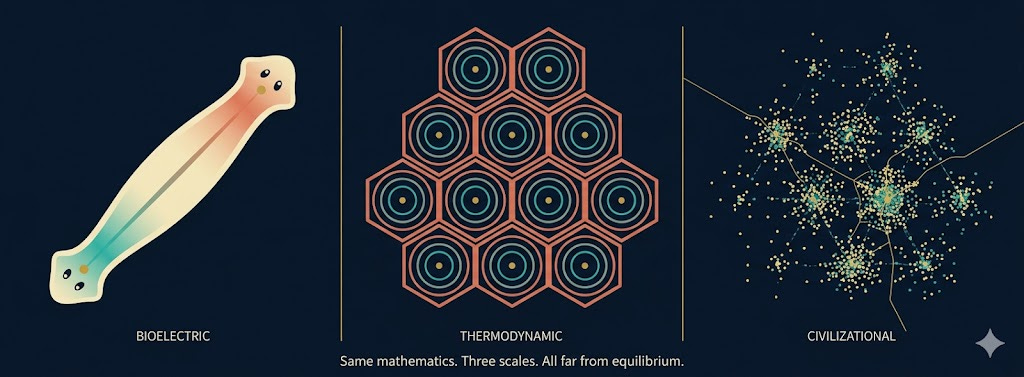
What follows is a sketch that builds on the formalization of Observer Coupling from The God Conjecture. The formal anchors are from the Observer Theory Extension. This discussion below is tentative and subject to revision.
I have been trying to understand why some ideas reorganize civilizations in a generation, why some persist for millennia, why others collapse, and why the same machinery that built the Royal Society also built Lysenkoism (a state-enforced denial of genetics under Stalin — weird, deadly and here, instructive).
The question matters. We have spent the last hundred years expanding our coupling technologies (print, broadcast, social networks, recommendation algorithms, LLMs) faster than we have built the thing that would tell us whether the rules we’re propagating are any good.
This speed problem is the thing this essay names. Most of what comes after follows from it.
II
You are an Observer. So is a cell, an institution, a thermostat and an ant. Each samples a portion of the full space of computational possibilities — what Stephen Wolfram calls the Ruliad1 — and treats that portion as reality. The sample is constrained by three things: how much computation you can do, how long you persist, and which patterns you notice.
An Observer is anything that takes in information, processes it, and responds. The Ruliad is the mathematical name for the space of every possible computation that could ever happen. You can only see and process a tiny slice of it. That slice is your experienced reality. A bacterium and a hawk live in the same forest only as a manner of speaking — each samples its own reality from the same underlying possibility space.
Time is not an external coordinate. An Observer with twice the computational capacity in the same persistence window experiences twice as many subjective ticks per (universal time) update. Different observers run different clocks. A mayfly’s life is, from inside the mayfly, doesn’t feel short.
Observers couple.
When two share information, the rate of mutual influence (mutual information) has a conjectured structure: physical coupling (shared space, correlated sensory input), valuational coupling (aligned goals, shared utility), symbolic coupling (shared language, shared concepts), and what for lack of a better word might be called archetypal coupling (the example I go for is pre-verbal recognition, the kind of communication that happens before a child learns words)2.
These layers are nested, like Russian dolls. The physical sits inside the valuational, the valuational inside the symbolic, the symbolic inside the archetypal (recursively, ad infinitum).
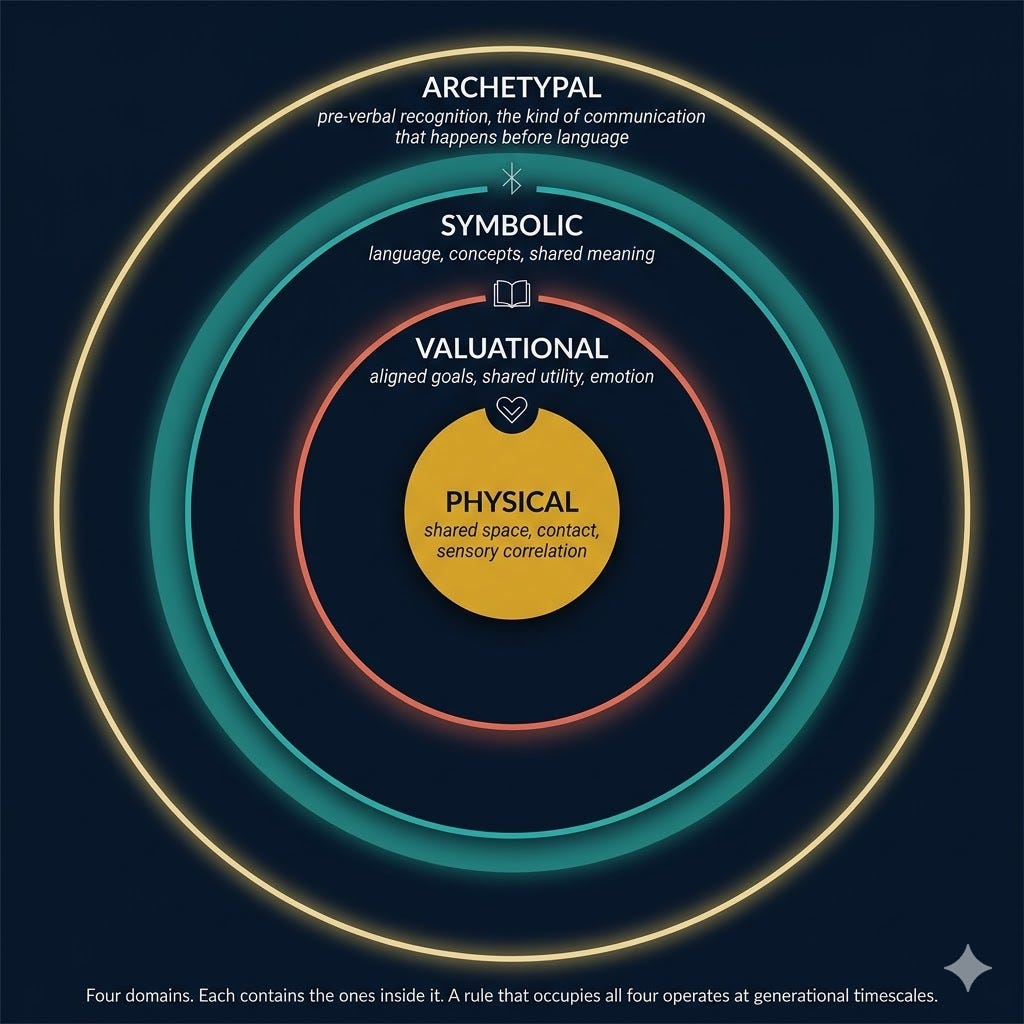
Coupling is how Observers share what they know. I have proposed four layers (based on our own cognition, you don’t have to use them — the actual domain mechanism is mechanically drawn around rule constraint), each contains the ones below it. The biggest domain is the wordless one — the way you can read a face across a room, the way a cell knows it is part of a heart. Below that sits language, then values / emotions, then physical presence. Two Observers can be strongly coupled at one layer and not at another. A book couples you to its long-dead author; a stranger on the same train couples you physically (albeit minimally).
Above the scale of a village, which covers every human society of the last ten thousand years, coupled-Observer networks settle into small-world topologies. High local clustering. Short global paths. Information travelling quickly because a small number of bridges connect distant clusters. Six degrees of separation is the cultural shorthand; the mathematics is from Watts and Strogatz’s 1998 paper in Nature. The experimental confirmation runs from Milgram in the 1960s to social-graph studies (whose participant counts are measured in the billions).
A small-world network is one where almost everyone is connected to almost everyone else by a short chain of intermediaries (but most of the connections are local). Your village, plus a few bridges that reach across to other villages, is a small-world network. The internet is. Most living tissue is. The structure is excellent for spreading information quickly across enormous distances. It is terrible for filtering which information should or shouldn’t spread.
Small-world topology is the worst structure for filtering bad rules and the best structure for spreading good ones. A rule discovered in one cluster reaches the whole network in time that scales as the logarithm of network size (once the coupling density exceeds a critical threshold).
Whether the rule is good or bad is irrelevant.
Today, every rule moves like Usain Bolt.
III
In 1900 Henri Bénard heated a layer of fluid from below and got hexagons. The pattern was not in the fluid and not in the heater; it emerged from sustained energy flow. Ilya Prigogine spent the next seven decades working out the math of more elaborate cases — the Belousov-Zhabotinsky reaction, where a chemical soup spontaneously generates oscillating spiral waves; the Brusselator model that explained why; the broader theory of dissipative structures that won him the Nobel Prize3.
A dissipative structure is a pattern that holds itself together by burning through energy. A whirlpool is one. So’s a hurricane, a cell and a civilization. None of them are at thermodynamic equilibrium; all of them would dissolve into noise if the energy stopped flowing.
Near a critical threshold, the system stops behaving like its average. The variance grows. Small fluctuations are amplified. The system reorganizes around the amplified fluctuation, often abruptly, and what comes out the other side is something entirely new. The question “what does the average particle do” stops being meaningful. Small, internally coherent sub-networks take the reigns of the broader system.
A bifurcation is the moment when a system that has been running smoothly suddenly switches to a different mode. Heat the fluid past a critical point and convection cells appear. Push a forest past a critical density and crown fires become possible. Push a society past a critical coupling density and what one cluster believes becomes what every cluster believes. Bifurcations are how complex systems organise themselves. But near a bifurcation, the system is no longer well-described by its average behavior — small things matter, and the future of the whole pivots on the contribution of small coherent sub-networks.
Civilizations meet the criteria for dissipative structures with room to spare. They are open systems exchanging energy and information with their environment. They are far from equilibrium — a modern industrial civilization runs on roughly (this is ballpark guesswork!) ten thousand watts per capita against an equilibrium baseline of zero (less guesswork!). They develop coherent structures (institutions, languages, technologies, ideologies) that exist only as long as they are fed. They are subject to bifurcation. Weidlich’s sociodynamics in the 1970s and Haken’s synergetics in the 1980s did the formal work of extending dissipative-structure theory from chemistry into social systems.
Good bifurcations produce the Reformation, the Enlightenment and the Scientific Revolution.
Bad ones produce something altogether different.
IV
A bounded Observer cannot extract every regularity that exists in its accessible field (the part of reality it samples from). It can only extract the regularities that fit within its compute budget. The measure of how much structure an observer can pull out, and how much remains beyond its reach as effective randomness, was introduced last year under the name epiplexity4.
The measure resolves a paradox in classical information theory: a cryptographically secure random number generator has near-maximal Shannon entropy but near-zero usable structure. Shannon entropy cannot distinguish a random string from a deterministic string.
Epiplexity can.
Classical information theory asks how unpredictable a string is. Shannon’s answer measures entropy. A string of random coin flips and a string produced by an encrypted counter both look maximally random to Shannon, but only one of them actually is random — the other has perfect structure that no bounded observer can find. Epiplexity is the measure that distinguishes them. It asks: given my computational budget and the time I have to think, how short a program can I write that compresses this data? If the answer is short, the string is structured. If the answer is essentially as long as the string itself, the string is effectively random — for me.
The version that matters for what follows is Observer-relative. Two Observers looking at the same underlying state do not even receive the same raw footage. Each one’s sampling functor produces a different coarse-grained data sequence; each one’s foliation slices the Ruliad differently. The Observer-relative epiplexity, written S_O(x), is the length of the shortest program that an Observer with computational budget B_O can run, within the persistence window τ_O, that compresses the data the observer sees when it looks at state x5.
Two Observers staring at the same scene do not see the same data. A dog and a person at the same beach are sampling different cross-sections of reality, weighted differently by what their nervous systems are built to integrate. Observer-relative epiplexity takes this seriously — the question is not “how much structure is in the state” but “how much structure is in what this particular observer can extract from this state given the compute it can throw at the problem.”
Rule discovery is the act of finding a shorter (more compressed) program. An Observer that finds a new compression of its data has reduced its epiplexity at that state. The trajectory leading to that state can now be traversed with fewer computational steps; the Path Cost — the total work an Observer needs to invest in getting from one state to another — falls.
Here we run into an asymmetry that drives this essay.
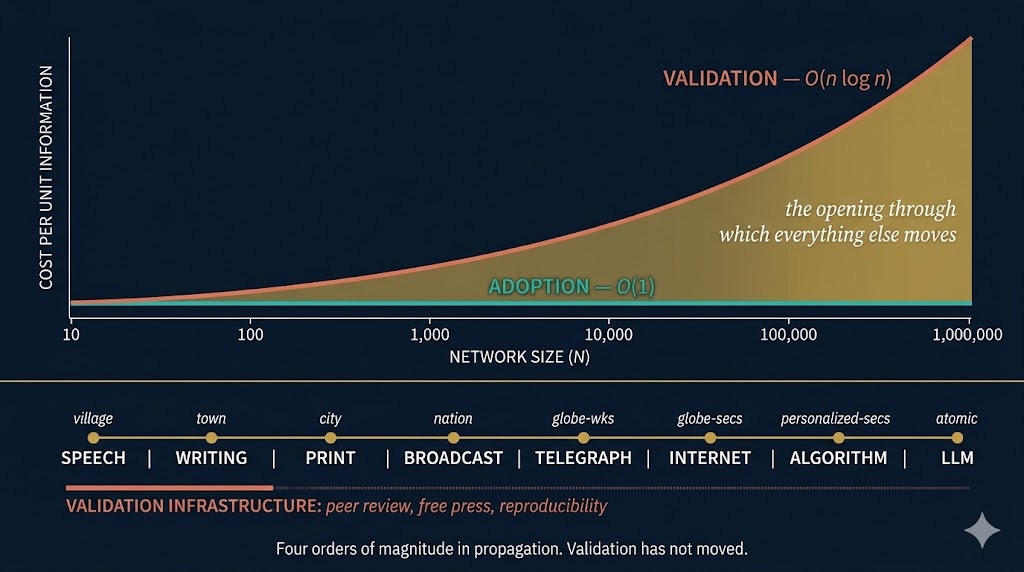
Rule discovery is expensive in absolute terms but exceptionally cheap relative to the value extracted; once found, the rule is reusable. Rule adoption is cheaper still; a new Observer copies the rule at the cost of one transmission. Rule validation is the cost of checking that the rule corresponds to a real regularity in the underlying state, rather than to an artefact of the Observer’s particular boundedness and coarse-graining (physics is exceptionally good at this!). Validation requires comparing the rule’s predictions against accumulated evidence across many possible trajectories. It scales with the logarithm of network size (at best), and it cannot be parallelized below a fundamental limit set by the rule’s reach.
Adoption cost: O(1). Validation cost: O(n log n).
Every coupled-Observer system in nature exhibits this asymmetry (different ratios, but I’m proposing the asymmetry itself, like most things in Observer Theory, is universal). It makes civilizations possible. It also causes them to fail.
For intuition: figuring out that fire cooks meat is hard. Telling another person about it is easy. Checking whether the cooked meat is actually safer over a hundred generations is harder still. The middle step (telling) is much cheaper than the steps on either side. This is the central asymmetry of every learning system in nature. It is the engine of civilization, because cheap transmission lets us share what one of us discovered. It is also the vulnerability of civilization, because we transmit much faster than we can verify.
A small coordinated sub-network can pool its compute and discover rules above the individual epipleptic capacity of any of its members. The pooled rule, once found, propagates at adoption cost. Validation, which the rest of the network is responsible for, lags.
V
Let’s revisit Levin’s lab. We have a worm whose head is where it’s arse should be. The animal is otherwise healthy. If you cut it in half, both halves will regenerate; the half with the displaced head will produce more two-headed worms, generation after generation, without any change to the DNA.
The instruction he altered was bioelectric: a standing voltage pattern across the regenerating tissue, encoded in the membrane potentials of cells (coupled via gap junctions), that tells each cell what the body is meant to look like.
Gap junctions are the physical instantiation of Observer coupling (modelled as a tensor — but if you’re feeling fancy, you can also probably use Markovian maths see Hoffman and Friston for this) at a cellular scale. They are protein channels that allow charge to pass between adjacent cells.
Each layer of the four-domain coupling structure has an analogue inside tissue. Physical coupling is electrical and chemical contact. Valuational coupling is shared metabolic stakes — your fate is mine (at least locally!) Symbolic coupling is the standing voltage pattern that encodes the target morphology (yes, you can make this all 0’s and 1’s). The archetypal layer (in biology, speculatively) is the morphological attractor itself, the cell’s recognition that the tissue around it is becoming a head or a tail or a limb.
Plain English: A planarian’s body shape is not stored in its DNA. DNA codes for proteins; the proteins build cells; the cells negotiate their voltages with their neighbors; the negotiated voltage pattern is the instruction set for “where the head goes.” If you scramble the voltage and let the worm regrow, it grows into the shape its voltage now describes — even if that shape never existed in its evolutionary lineage. Shape is consensus, and consensus can be edited without touching a single gene.
This lets us redescribe pathologies. Cancer, under this framing, is a sub-cluster of cells that has detached from the tissue’s bioelectric field and reverted to a more ancient programme (proliferate, ignore the signal). The gap-junction channels through which the tissue speaks to itself are downregulated; Yamasaki’s connexin work and Trosko’s research on intercellular communication suppression have shown this for thirty years6.
In the language of network theory the cluster has low Cheeger conductance (in my view, the most punnable piece of mathematical apparatus we’ve developed) to the surrounding tissue — its internal coupling vastly exceeds its coupling to the host. In the language of the labs it is a local attractor that does not engage with the global morphogenetic trajectory.
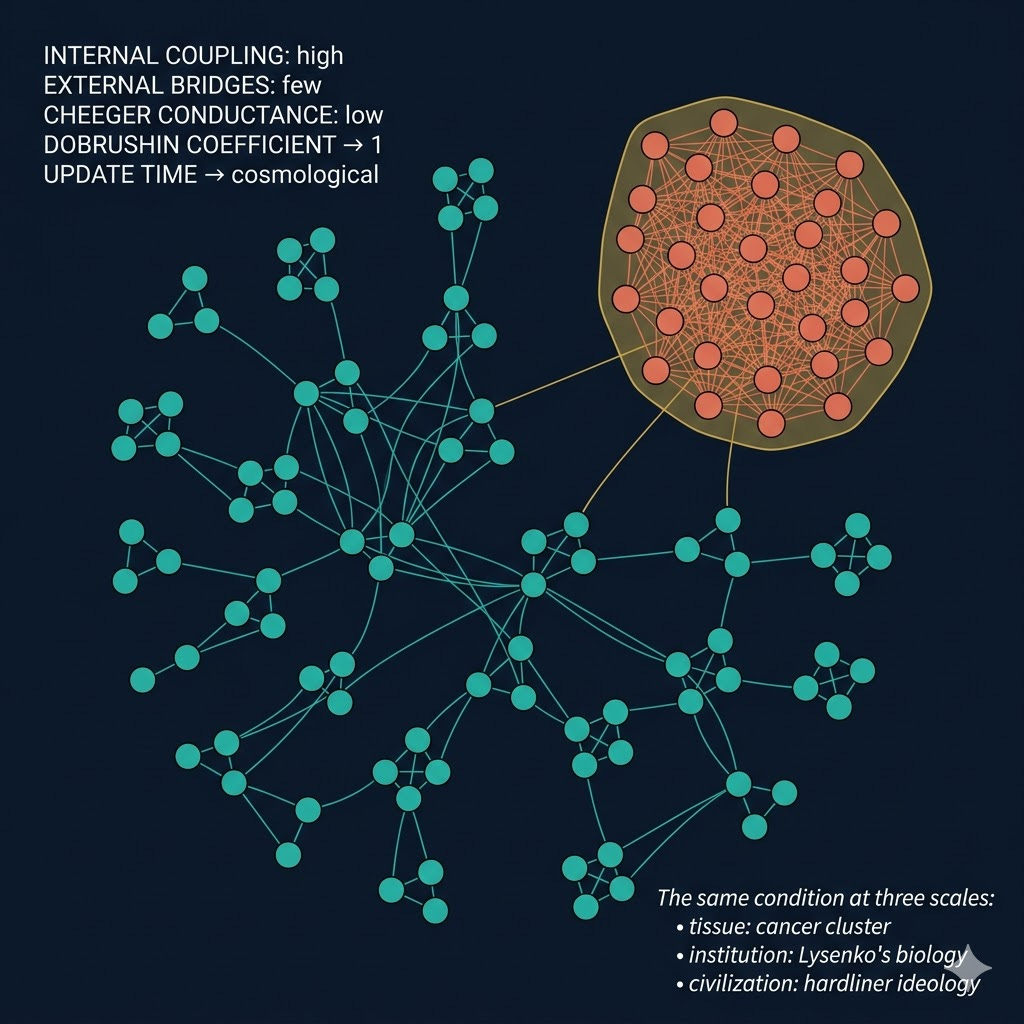
Cheeger conductance is a number between zero and one that measures how well-connected a cluster is to the rest of the network it sits in. High conductance means lots of bridges out, lots of information flow in and out, easy to update. Low conductance: few bridges, cluster talks to itself, hard to update. Cancer cells have low Cheeger conductance to the tissue around them. Their gap junctions are closed. They are still cells; they have just gone deaf.
In the language of the convergence proof, the cancer cluster sits at a configuration whose rate of update under external coupling is bounded (above) by the Dobrushin contraction coefficient of the joint update operator — a coefficient close to one whenever Cheeger conductance is small7.
The connection is exact: low conductance bounds the spectral gap of the cluster-meta-tissue update from above, which bounds the Dobrushin coefficient from below, which slows mixing. The cluster does not update. It does not die. It grows.
In Plain English: when a cluster’s connections to the outside are weak, the cluster’s beliefs and behaviors can resist external evidence almost indefinitely. The technical name for the ‘resistance rate’ is the Dobrushin coefficient. The smaller the cluster’s bridges to the rest of the world, the closer to one this coefficient is — and once it is at one, the cluster is disconnected. This is a mathematical reason that cancer kills people. It is also, structurally, the mathematical reason institutions destroy themselves.
That is the disease at the cellular scale. The next question is whether the same structural condition can occur at the scale of people.
VI
Coupling technologies are infrastructure that shorten the effective network distance between Observers.
In the propagation kernel, information from a discovered rule decays exponentially with distance: I(d) ∝ e^(-d/λ), where λ is the characteristic decay length of the network8. A coupling technology reduces λ. Each successive development humanity has made has reduced it.
Think of λ as how far a whisper carries before it fades away. Each technology that humans have invented has made the ‘effective whisper-distance’ longer. A campfire reaches a small clan. A printed pamphlet reaches a city. A broadcast reaches a nation. An algorithmic feed reaches a planet, instantly. The mathematical structure of the propagation does not change. Only λ changes, and it grows exponentially at phase transitions.
The phase-transition condition for collective rule propagation is well-established in broader sociophysics literature. Above a critical product of average coupling strength and network size, a rule that begins in a single cluster reaches the whole network in logarithmic time to network size. Below that threshold, the rule dies in the cluster that found it. The empirical question is where the threshold sits, and on this we have data.
Xie et al worked with the Naming Game model in 2011. They found that committed minorities in social networks could reverse the majority opinion when their share crossed a threshold between four and fifteen percent (depending on network sparseness). Damon Centola at the University of Pennsylvania, working with live human subjects in a 2018 paper in Science, found the threshold sat at approximately twenty-five percent9.
In one trial a single additional committed person was the difference between failure and reversal of a social norm. Doubling and tripling the financial reward for sticking with the established behavior did not prevent the minority from prevailing. Both studies measure shallow opinion shifts in controlled networks, and the extrapolation to deep institutional dynamics is conceptual. The thresholds bracket a range. They calibrate the phase-transition condition.
They do not, on their own, prove anything about civilizations.
A “committed minority” in these studies is a sub-network of participants who refuse to update. Everyone else updates according to local social pressure. The result, replicated multiple times in lab settings and observed in field studies, is that once the committed minority is large enough — somewhere between four and twenty-five percent depending on the network — the majority gives way. The threshold is much lower than majority, the bar that democratic intuition expects. This is the central empirical fact this essay is wrestling with.
A separate result in 2007 distinguishes simple and complex contagions. A simple contagion — a fact, a virus, a single piece of information — spreads on contact. A complex contagion requires reinforcement from multiple distinct sources before adoption10. The cultural revolutions that change deep social norms are complex contagions. They need wide bridges in the network. Today, the contemporary elite institutional structure provides wide bridges abundantly, where the equivalent structures of the late nineteenth century did not.
A simple contagion is something you catch on one exposure: a fact, a virus, a tune you cannot stop humming. A complex contagion requires hearing the same message from several different trusted sources before you adopt it: a moral norm, a serious political conviction, a paradigm shift in a discipline. Complex contagions are slower but stickier. The infrastructure that makes them possible is wide bridges — clusters of trusted sources who agree with each other. The modern elite institutional structure is built almost entirely out of wide bridges between distant clusters.
The infrastructure of rule propagation has grown by something like four orders of magnitude over the last century (again, this is a very lossy estimate!) The cost of one Observer transmitting a rule to another has fallen from a letter delivered by sea (measured in months) to a post amplified by an algorithm (measured in seconds). The infrastructure of rule validation has not advanced comparably. Peer review still operates at the timescale of months to years; reproducibility, years to decades. The window between rule emergence and the critical threshold crossing has compressed from generations to weeks.
The window for validation has not moved.
VII
The Catholic Church spent one hundred and fifty years refusing to update its model of the solar system. The astronomical observations were available; the maths for analyzing them was, by the seventeenth century, fully developed.
The Church’s institutional coupling structure — its internal mutual reinforcement, its theological commitments, its institutional incentives — were sufficient to absorb that evidence without updating for more than a century. The Church was not, during this period, deceived about the facts. The Church was a hardliner cluster whose Cheeger conductance to the broader scientific community had fallen below a level at which correction could propagate.
The Soviet biological establishment under Trofim Lysenko spent seventeen years denying that genes existed (in the sense that Western biology said they did). The denial was costly. Crop yields fell off a cliff. Geneticists were imprisoned, exiled, or shot. The denial persisted because Lysenko’s cluster was internally networked to a degree that exceeded its coupling to the broader scientific community. By the time it collapsed, Soviet biology was a generation behind. The catch-up took a generation more.
The convergence theorem makes the duration intelligible.
Cross-basin mixing time scales as O(1/ε), where ε is the effective noise floor — the rate at which evidence from outside the cluster gets through to its members11.
Paradigm shifts are rare precisely because the macroscopic noise floor is small. When a cluster’s internal coupling produces a precision-weighting in favor of its own predictions that vastly exceeds the precision it grants to external evidence, ε shrinks toward zero and the mixing time grows. The Church did not change because the noise floor was small. Lysenkoism did not collapse until the noise floor exceeded the cluster’s internal coherence — which, in that case, required Stalin’s death and generational turnover.
Imagine a deep valley separated from the next valley by a high ridge. A ball rolling around in the valley will mostly stay in the valley. Only every now and then does a random gust of wind kick it hard enough to clear the ridge. The smaller the gusts, the rarer the crossings. Cross-basin mixing time in social systems is (sort of) the same. Hardliner clusters are deep valleys. The noise floor is the random gust. When the gust is small, the cluster persists for (cosmologically) long times. Galileo’s church took a hundred and fifty years; Lysenkoism took seventeen; the contemporary case, which has access to coupling infrastructure that deepens the valley further, may take longer, absent new architectures.
The contemporary case is the institutional capture in elite Western universities, media organizations, professional accreditation bodies, and corporate compliance departments that has been loosely termed ‘Wokeness’.
The structural features match.
A small coordinated sub-network discovered a powerful and simple rule — that group identity is the primary explanatory variable for outcome disparity and that the appropriate response to disagreement is moral exclusion — and propagated it across the network with the speed available to coupled systems running on contemporary infrastructure. The rule has full domain realisation, which I will return to in Section IX.
Consider one moment in 2020. Two hundred and fifty Cravath summer associates signed a letter, originated within the firm, calling on the partnership to revisit hiring practices, billing practices, partnership composition, and pro bono allocation around an explicitly identity-categorical framework. Within eighteen months, near-identical letters had circulated at every comparable firm in New York and Washington, the formal hiring criteria at the top of the American legal profession had been re-codified, and the diversity-contracting industry that grew up around the re-codification began to generate revenues in the billions. None of the relevant partnerships voted on the change before it occurred. The change occurred because the cluster crossed a threshold. The validation followed afterward (if it followed at all!)
David Shor was fired by Civis Analytics for tweeting a peer-reviewed political science paper. Erika Christakis was driven out of Yale for writing an email about Halloween costumes. The Foundation for Individual Rights and Expression now catalogues more than a thousand documented cases per year of similar professional exits (academics, journalists, scientists, doctors) for offences whose definition shifts faster than the affected individuals can update their compliance. The training contracting industry that grew dramatically after 2020 generates billions in parasitic revenue. The disparate-impact doctrine is enforced through the federal civil rights apparatus on terms set by the cluster’s preferred framework. Faculty composition across the senior academic disciplines that historically validated institutional knowledge claims has been re-shaped by hiring quotas that the framework predicts and the data confirms.
The cluster is asymptotically stable absent sustained intervention.
What distinguishes the contemporary case from Galileo’s church and Stalin’s biology is the technology. Earlier hardliner clusters were isolated by geography, by literacy, by the speed of print. The contemporary clusters have access to coupling infrastructure that shortens network distances to milliseconds and amplifies homophilic reinforcement algorithmically. The basin is deeper, and the precision on confirming evidence higher, than in the historical cases.
Levin’s planarian has the wrong head on it and cannot put it right. The structural condition at the civilizational scale is the same.
VIII
The convergence proof for Observer Theory establishes the structural result that anchors this essay. The framework proves three theorems that together formalize the God Conjecture’s central claim.
The first gives finite-time convergence of any deterministic observer’s iterated update to a fixed configuration — within at most |R_O| steps, where R_O is the size of the observer’s accessible state space. The proof is elementary: the Data Processing Inequality establishes that entropy is non-increasing under observation, the non-degeneracy condition (C1) makes it strictly decreasing on non-fixed states, and finiteness plus monotonicity gives termination.
Any finite observer that keeps observing eventually settles down. The proof is reducible to a pigeonhole argument. There are finitely many states. Each observation strictly reduces entropy. You cannot strictly reduce entropy forever in a finite system. So the dynamics reach a fixed point in bounded time. This is the deterministic story: observation terminates, and what it terminates at is what the framework calls a persistent structure.
The second gives exponential convergence for stochastic observers via the Dobrushin contraction coefficient. The contraction is on the space of probability distributions over the Observer’s state space; Banach’s fixed-point theorem on a complete metric space gives a unique limiting distribution to which all initial conditions converge.
Add noise to the picture — measurement uncertainty, quantum fluctuations, the inescapable imperfection of any real Observer — and the deterministic story sharpens. The dynamics now converge not to a single state but to a unique probability distribution, and they converge exponentially fast. The rate of convergence is set by the Dobrushin coefficient. The destination is unique. The journey is fast within a basin and slow across basins.
The third extends this to non-stationary environments under weak ergodicity. The fourth result is interpretative and categorical (rather than dynamical). It establishes that all Observer equilibria are structurally connected to a single terminal object, TI, via unique morphisms. TI, here, is definitional: a contractive point at infinity that acts as the universal limit of the Ruliad’s categorical formalism. The theorem does not say Observers reach this point. It says the persistent structures they converge to are all related to the same categorical limit, in the same way every point on a globe has a unique shortest path to the north pole.
Every persistent structure that any Observer converges to has a unique structural relationship to the end of the line. This is a (slightly more) formal analogue of the intuition that mathematicians in different cultures discover the same theorems, that physicists arrive at the same conservation laws from different starting points, that ethical traditions converge on a recognizable core. The convergence is real and now proven (in a limited form! I’m working on the rest, but I need all my math checked by much brighter people than me, so it takes time!). Persistent structures are features of the territory, not contingent features of any particular Observer’s map.
The work proves the gradient component of Observer dynamics. It does not prove anything about the exploratory half.
The solenoidal gap is the most important open question I am working through. It is also the most overlooked question in AI alignment. LLMs perform gradient descent on a fixed objective. They don’t circulate. They don’t deliberately explore (at constant surprisal). The directed exploration that biological Observers achieve through curiosity and play is the solenoidal component that the current Observer Theory formalism does not yet capture and that current LLMs do not architecturally instantiate.
What this means for the present argument is that the convergence half of the story — the gradient dynamics that this essay has been describing — is rigorous but incomplete. The structural fragility of civilizations is real (and half-way proven), in the dissipative dynamics. The structural creativity of civilizations — the part where directed exploration discovers new attractors rather than settling into existing ones — is not formalized. The architectural prescriptions that close this essay address the gradient half of the problem. The other half is open.
Observer coordination amplifies whatever vector you are already pointing at. The Royal Society and the Inquisition ran the same gradient machinery in opposite directions. The civil rights movement and the Cultural Revolution ran the same gradient machinery in opposite directions. The validation part — the alignment of the propagated rule with the underlying regularity — is what determines whether the system vector is pointing to good or to bad. The maths is direction-neutral.
The ground does not know its own gradient.
IX
If coordination is direction-neutral, persistence is not. Persistence has a structure, and the structure is composition.
A rule that works in one of the four domains has a short half-life. A slogan is symbolic and decays within months. A market sentiment is valuational and lasts a quarter. Persistence requires composition. A rule that has acquired non-trivial realization in all four domains — physical, valuational, symbolic, archetypal — operates at generational timescales12.
Christianity is the textbook example of a fully composed ruleset. The early movement was symbolic. It acquired valuational depth in the golden rule (love-thy-neighbor) as a network-coupling optimization. It acquired archetypal force in the sacrificial god, the resurrection (these patterns appear across multiple unrelated religious traditions, so we know, qualitatively, that they have deep psychological appeal). It acquired physical instantiation in sacraments, architecture, calendars and dietary rules. Each domain reinforced the others. The result was a fully composed structure that persisted for two thousand years and shaped a large chunk of human civilization.
A rule that lives in only one domain decays. A slogan without an emotional charge dies in a season. An emotion without a symbolic vocabulary dies in a year. An archetype without an embodied practice dies in a generation. Full composition — symbolic plus valuational plus archetypal plus physical, each layer reinforcing the others — is what makes a rule generational. Christianity composes fully. So does Confucianism. So does Wokeness, achieved across approximately a decade — which is why its persistence is the structural question of the present moment.
Wokeness achieved full composition in roughly a decade. It is symbolic, in a vocabulary trained into a generation of university students. It is valuational, in a moral frame that re-codes private virtue around public adherence. It is archetypal, in the oppressor-oppressed structure that has appeared in religious revivalism, in revolutionary millenarianism and in inquisitorial moral panics across the centuries. It is physical, in enacted compliance involving statements, gestures, hiring practices and dresscode. The composition is what makes it resilient against ordinary refutation. Refute any single domain and the other three remain intact, reinforcing the refuted domain via the aforementioned Observer coupling mechanics.
A second persistence mechanism deserves a brief mention. A coordinated sub-network can change not only what the MetaObserver’s nodes (here, the MetaObserver is the ‘whole’) believe but who occupies the nodes. Hiring, firing, deplatforming, admissions filtering, retirement timing — these are levers that change the composition of the MetaObserver itself. This is closer to Lewontin’s Triple Helix dynamic than memetics. The rule does not need to win arguments on merit. The rule needs to populate the seats from which arguments are evaluated. Most ideological clusters that achieve persistence operate on both axes simultaneously.
X
Over the last century we have built a coupling amplifier of enormous power. Each successive technology shortened the effective distance between Observers, increased the rate at which rules propagate across the network, and lowered the cost of one transmitting a discovered rule. The compounding has not stopped. Each new layer multiplies its predecessor.
We did not build the corresponding validation multiplier. The infrastructure of rule validation — the institutions, processes, and norms by which a propagating rule is tested against accumulated evidence before being treated as binding — is approximately what it was in the late nineteenth century. Peer review, free press, adversarial law, deliberative legislatures, scientific reproducibility studies. These were designed for a world in which a rule took years to travel and would be tested by the same generation that proposed it. They are out of step with the present. The proposals below are calibrated: the gap between O(1) and O(n log n).
We did not build the precision-management infrastructure either. In the language of Friston’s framework, a hardliner cluster’s resistance to updating is a hierarchical-precision phenomenon. Top-level priors (cluster identity, moral frame, accepted narrative) have very high precision in confirming contexts. The precision attached to disconfirming evidence has been algorithmically attenuated.
The architectural intervention becomes restoration of the precision signal of disconfirming evidence in hierarchical contexts where the attention infrastructure has stripped it. Friston’s framework gives the formal mechanism; the design space for implementations is large and largely empty.
In Active Inference, a “prior” is the brain’s prediction about what will happen next; “precision” is how confident the brain is in that prediction. High-precision priors absorb disconfirming evidence without updating because they discount evidence that disagrees with them. The contemporary attention infrastructure has been built to maximize engagement, which selects for content that confirms the user’s existing priors and de-prioritizes content that disconfirms them. The result is that disconfirming evidence arrives with attenuated precision — the brain receives it but does not weight it enough to update. Restoring the precision of disconfirming evidence is the architectural intervention.
We also failed to build the directed-exploration infrastructure (see ‘Master and Emissary / McGilcrest, who has the strongest position on this type of direction), and the solenoidal gap in the formalism mirrors a real gap in the institutions. The architecture that produces virtuous bifurcations is one that supports active exploration of the possibility space — the deliberate funding of investigations whose outcomes are unpredictable, the protection of researchers and dissenters whose work does not converge on any current basin, the institutional patience for paths whose value will be apparent only in retrospect. These are exactly the practices that an attention economy optimized for engagement and a research economy optimized for short-term metrics (published papers, piecemeal progress) actively erode. The solenoidal component of civilizational dynamics is what we are most rapidly losing infrastructure for.
Five sketches for restoring this component follow.
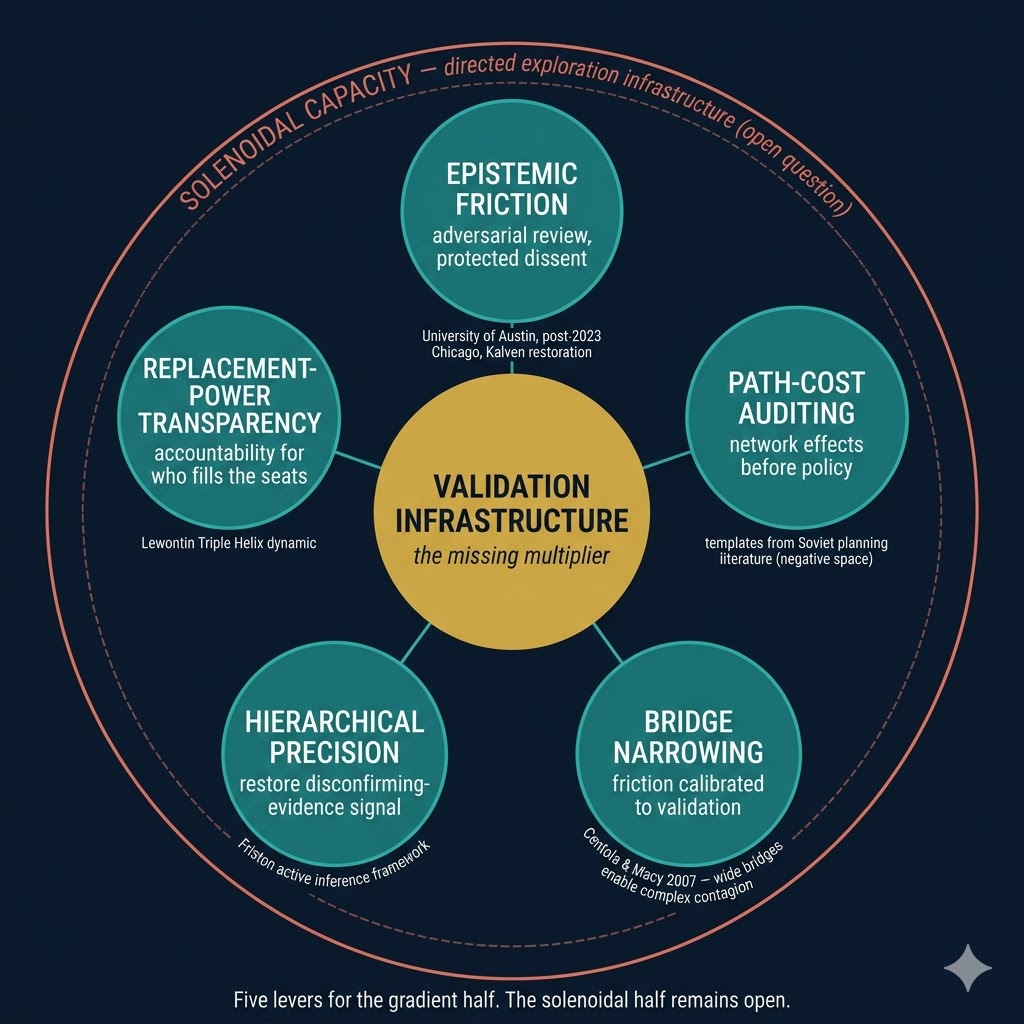
First, epistemic friction inside institutions. Mandatory adversarial review of dominant frames at periodic intervals. Structurally protected dissent positions whose occupants are not subject to ordinary social cost for disagreement (this use to be what tenure was for!) Rotation requirements on positions where the occupants control the validation phase. The University of Austin, the post-2023 reforms at the University of Chicago and the restoration of the Kalven Report’s institutional neutrality are early prototypes. They work. They show that the basin can be unwound where the will to change exists.
Second, path-cost auditing for new operational frames before they cross into binding policy. Any frame proposing to reorganize an institution should be required to demonstrate, before implementation, the global path cost — including network effects on Observers outside the proposing cluster. The Soviet planning literature, ironically, provides templates for this kind of auditing, in the negative space of what it failed to do.
Third, narrowing the wide bridges that enable complex contagion of mis-validated rules. Centola and Macy showed that complex contagions need wide bridges. The contemporary algorithmic architecture is built to provide them at industrial scale. A simple architectural intervention is to insert friction at the bridges — particularly those carrying high-stakes claims, in proportion to the validation status of the rule being propagated. Friction calibrated to impact.
Fourth, hierarchical-precision restoration for high-stakes claims. This intervention aims to restore the signal of disconfirming evidence in algorithmically homophilic environments where it has been suppressed. The technical design space is large. Some of the work has been done; most has not.
Fifth, replacement-power transparency. When a coordinated sub-network operates the levers that change who occupies the superstructure / MetaObserver nodes (admissions, hiring, firing, deplatforming), the levers themselves should be subject to validation review.
So, after slogging through all my directions, I come to the question that always needs to be considered when thinking about new things I’m formalizing.
What are the falsification criteria?
I think this is potentially easier than the computational theology work. Three claims are testable (in principle, please note these are very rough and underspecified, I normally do this at the end, but I’m trying to foreground this moving forward as better research practice. Bear with me, I know it’s not my strongest suit).
First, small-world topology with sufficient clustering predicts elevated risk of cross-domain rule capture above a measurable phase-transition density; falsified by institutions with the relevant topology that show no capture, or institutions without the topology that show capture.
Second, that committed-minority opinion reversal crosses between ten and twenty-five percent depending on network conductance; falsified by documented cases substantially outside that bracket in either direction.
Third, that ideologies achieving realization across all four nested observer domains show generational persistence, while those realized in fewer decay within network-tick timescales; falsified by single-domain ideology persisting across generations, or four-domain ideology decaying rapidly.
If the direction is fruitful and provable, the architectural prescriptions follow. If it is wrong, the prescriptions need different scaffolding. Either way the diagnostic question is sharper than it was: what infrastructure does a civilization need to keep the rules its observers discover in coupling with the rules its composed MetaObserver (i.e. the whole civilization in aggregate) would test against the long-running record?
Levin’s two-headed planarian is alive in a dish at Tufts. It will live there for years. Its body has settled on the wrong attractor, and there is no available mechanism within the worm by which it can find its way back to the right one. The voltage pattern has won. The genes are silent.
We are running the same experiment across our planet. We should probably learn the rules and the confounds.
The Ruliad is Wolfram’s term. It has been formalized as an ∞-groupoid whose objects are all computational states and whose morphisms are all computational transitions generated by all possible rules. Formalized category-theoretically in Arsiwalla and Gorard (2021), Pregeometric spaces from Wolfram model rewriting systems as homotopy types. The functorial definition is in Senchal (2025a), Observer Theory and The Ruliad: An Extension to the Wolfram Model, Definitions 3–4.
The sampling functor S_O : R → R_O has image R_O ⊂ R constrained by boundedness, persistence, and relevance. The Field of Observation F_O ⊆ R_O is the subset currently being sampled. The MetaObserver — an observer whose accessible Ruliad contains the union of any finite collection of observers’ accessible Ruliad — exists as a rule in R as a matter of theorem rather than assumption (Convergence Paper, 2026), though physical instantiation of any specific MetaObserver may not be realizable within a particular universe’s computational budget.
The four-domain coupling tensor Ψ_i,j is defined in Senchal (2025b), The God Conjecture, as Ψ_ij = Σ_d w_d × overlap_d × coherence_d for d ∈ {P, V, S, M}.
The nesting M ⊃ S ⊃ V ⊃ P is established via embedding functors S_{d,d’} : D_{d’} → D_d. Domain weights w_d remain posited rather than derived; calibration is a current research-direction.
Primary Prigogine references: Nicolis, G. and Prigogine, I. (1977). Self-Organization in Nonequilibrium Systems: From Dissipative Structures to Order Through Fluctuations. Wiley. Prigogine, I. (1977). Time, Structure, and Fluctuations. Nobel Lecture, December 8. Prigogine, I. (1976). Order through fluctuation: self-organization and social system. In Jantsch (ed.), Evolution and Consciousness: Human Systems in Transition, Addison-Wesley.
The Bénard cell predates Prigogine’s primary work and was generalized by him within the broader dissipative-structure framework. The Belousov-Zhabotinsky reaction is closer to Prigogine’s own paradigm. Both are valid examples of the general phenomenon.
(N.B. I am not a chemist. I have read summaries of this work, thanks Claude / Gemini for the heavy lifting. I did check these books exist though! Doing work that touches this many disciplines means I can’t read every entire book / paper for the direction articles - clue its what the discussion, the abstract and results are for. When I actually work on the paper, I will obviously read the primary source.)
Finzi, M., Qiu, S., Jiang, Y., Izmailov, P., Kolter, J.Z., & Wilson, A.G. (2026). From Entropy to Epiplexity: Rethinking Information for Computationally Bounded Intelligence.
Epiplexity is defined in Definition 8: for random variable X on {0,1}^n and a time-bounded probabilistic model P in the class P_T, S_T(X) := |P*| where P* = argmin_{P ∈ P_T} {|P| + E[log 1/P(X)]}.
Total time-bounded information content is MDL_T(X) := S_T(X) + H_T(X). The framework resolves the CSPRNG-versus-randomness distinction that classical Shannon entropy cannot. I am currently about half-way through adapting this measure for Observer Theory.
It is so obviously a better measure than integrated information (sorry Giulio, sorry PID, sorry Anil Seth - this is just much more intuitive and simulateable)
The Observer Theory extension is in draft now. Provisional (and very shit title!) Observer-Relative Information Decomposition (ORID): Extending Epiplexity to the Ruliad, Rough definition:
S_O(x) := |P_O(x)| where P_O(x) = argmin over Prog_O of {|P| + L(D_O(x) | P)}, with Prog_O the set of programs whose runtime and memory are bounded by B_O.
The key change relative to Finzi is the second axis of observer-relativity. We want to look at more than computational capacity. We also should consider observational access via the sampling functor’s induced data sequence D_O(x). The work is trying to establish foliation invariance (how we see the same stuff!) up to a bounded constant κ (which is analogous to Kolmogorov’s invariance theorem, but this is so far from complete that I may have to roll this back. If anyone from the Epiplexity team reads this and wants to check my work / please help it would be appreciated :D)
The bioelectric framework: Levin, M. (2014). Molecular bioelectricity: how endogenous voltage potentials control cell behavior and instruct pattern regulation in vivo. Two-headed planarian work: Durant, F., Morokuma, J., Fields, C., Williams, K., Adams, D.S., Levin, M. (2017). Long-Term, Stochastic Editing of Regenerative Anatomy via Targeting Endogenous Bioelectric Gradients. Cross-species head shape work: Emmons-Bell, M. et al. (2015). Gap Junctional Blockade Stochastically Induces Different Species-Specific Head Anatomies in Genetically Wild-Type Girardia dorotocephala Flatworms. Gap-junction suppression in malignancy: Yamasaki, H. (1990). Gap junctional intercellular communication and carcinogenesis. Carcinogenesis. Trosko, J.E., Ruch, R.J. (1998). Cell-cell communication in carcinogenesis.
Senchal, S.A. (2026). Convergence of Observer Dynamics in the Ruliad: From Conjecture to Theorem. Open Research Institute. Theorem 5.2 (Deterministic Convergence) gives finite-time convergence within |R_O| steps via Data Processing Inequality and finiteness. Theorem 6.7 (Stochastic Convergence) gives exponential convergence via Dobrushin contraction coefficient and Banach’s fixed-point theorem; the contraction rate δ(K^N) < 1 follows from primitivity. Theorem 6.11 extends to non-stationary environments under weak ergodicity (condition C2′). Theorem 8.4 (Universal Convergence) gives the categorical interpretation: TI is terminal in the category Fix of observer-equilibrium pairs, so every persistent structure has a unique structural morphism to TI. The Cheeger conductance bound on the Dobrushin coefficient for cross-basin mixing is standard (Levin, Peres, Wilmer 2009, Markov Chains and Mixing Times, Chapter 7)
The exponential decay kernel I(d) ∝ e^(-d/λ) for information propagation in coupled-observer networks is in Senchal (2025b), The God Conjecture, Phase Transition Proposition proof sketch (it is still a sketch, Observer Coupling is still a WIP).
The kernel-flattening interpretation of coupling technology is one possible extension. Specific scaling exponents for λ across technology generations are illustrative; the qualitative monotonic decrease is supported by the case-study data in the same source — international co-authorship rate 15% to 50% between 1990 and 2020, discovery-to-application time approximately 50 years (1900) to 5 years (2020).
Xie, J., Sreenivasan, S., Korniss, G., Zhang, W., Lim, C. & Szymanski, B.K. (2011). Social consensus through the influence of committed minorities. Physical Review E 84, 011130.
Small caveat on the above reference. Result was in paper was c.10%. Secondary literature on different topologies provides the 4%-15% range mentioned in the main body.
Centola, D., Becker, J., Brackbill, D. & Baronchelli, A. (2018). Experimental evidence for tipping points in social convention. Science 360(6393). Galam, S. & Jacobs, F. (2007). The role of inflexible minorities in the breaking of democratic opinion dynamics. Physica A 381. Mobilia, M., Petersen, A. & Redner, S. (2007). On the role of zealotry in the voter model. Journal of Statistical Mechanics P08029. Both Xie and Centola measure shallow opinion shifts in controlled networks; their extrapolation to deep institutional dynamics is conceptual rather than directly empirical.
Centola, D. & Macy, M. (2007). Complex contagions and the weakness of long ties. American Journal of Sociology 113. The technical distinction: simple contagions propagate on single-source contact; complex contagions require reinforcement from multiple distinct sources before adoption. Implication for network design: short cuts (Watts-Strogatz long ties) are efficient for simple contagion but inefficient for complex contagion, which propagates better through wide-bridge connections between local clusters. Guilbeault, D. & Centola, D. (2021). Topological measures for identifying and predicting the spread of complex contagions. Nature Communications 12, 4430, formalises this further.
The noise-floor result is in my convergence paper, Section 3 condition C2′(c) and Remark following.
The Dobrushin coefficient satisfies δ(K^N_max) ≤ 1 − n_max ε_min; convergence timescale scales as O(1/ε_min). The macroscopic noise floor ε_min is many orders of magnitude smaller than its quantum-mechanical lower bound (Zurek 2003, Decoherence, einselection, and the quantum origins of the classical, Rev Mod Phys 75); the difference is what makes paradigm shifts rare at the social scale even though they are guaranteed at the limit. Cross-basin equilibration times of cosmological order are admitted by the theorem.
N.B. This is a sketch - not all of this is formalized fully. It’s certainly not proven in any robust respect. But directionally, take this as what the intuition is.
Composition across nested domains: an Observer’s accessible field F_O contains four nested domains via embedding functors S_{d,d’} (Senchal 2025a, Definitions 7–8).
A program φ ∈ Prog_O is fully composed on concept C if its restriction π_d(φ) realizes C non-trivially in each domain d ∈ {P, V, S, M}.
The composition is a multi-resolution structure under the nested embedding functors as opposed to a tensor product. In the comparative-theology bridge that runs through the broader project, fully composed concept-morphisms across all four domains correspond to what Lurianic Kabbalah names malachim (angels) — specific named morphisms each carrying a complete computational function within scope. This is poetic correspondence and not a formal claim. The question of whether convergence to such structures derives from shared cognitive architecture (Atran 2002; Boyer 2001) or shared reality structure is the CF/CR decomposition flagged as open in the convergence paper.